 Stay
Stay 

Trading Conditions
Products
Tools


The 4-hour wave structure for EUR/USD is becoming more complex. There is still no question of invalidating the upward trend segment (lower chart), which began in January last year. On the contrary, a complete A-B-C corrective structure has emerged, which may be complete. However, recent developments related to the Federal Reserve and its policy have once again affected the current wave structure, making it more complex. It should be noted that the fundamental backdrop and wave structure often conflict with each other, making adjustments necessary.
The wave structure has now become more complex. Wave C has taken a three-wave form, while the next wave is identified as wave D. The entire trend segment beginning on January 27 may have taken a five-wave corrective form, A-B-C-D-E. If this assumption is correct, wave D is complete, and on August 21, EUR/USD entered the phase of forming wave E, the low of which should be below the low of wave C at 1.1325. The pair is now very close to this level, and below it, the presumed wave E could complete its formation at any time.
Market Sentiment Remains Unchanged
EUR/USD declined by another 30 basis points on Monday, and the euro was fortunate to lose only 30 points rather than 90. During the day, EUR/USD declined by as much as 90 points, but the euro subsequently managed to partially recover. A new wave of selling began after news emerged about France's budget problems, which will have to be addressed through unpopular measures. These include tax increases and cuts to government programs, particularly in education and social assistance. However, such measures are important not only because of potential dissatisfaction among French citizens, but also because budget problems are always a warning sign for investors. French government bonds continued to be sold, while their yields continued to reach record highs, as did US Treasury yields.
Thus, the debt problem is no longer limited to the United States. Investors are increasingly reluctant to invest in countries that have been unable to balance their budgets for years and decades, cannot operate without constant borrowing, and continue to increase their public debt. The war in Yemen also added to the pressure and risks becoming as prolonged as the war in Iran. Demand for the safe-haven US dollar is rising again, which is understandable when considering Monday's developments alone. However, the debt and budget situation in the United States is no better, and the market is currently not taking other factors into account. A relatively important US Services PMI for September was also released yesterday. Its reading was 54.9 points, compared with the market expectation of 55.0. The deviation was minimal, so the forecast was broadly in line with the actual result.
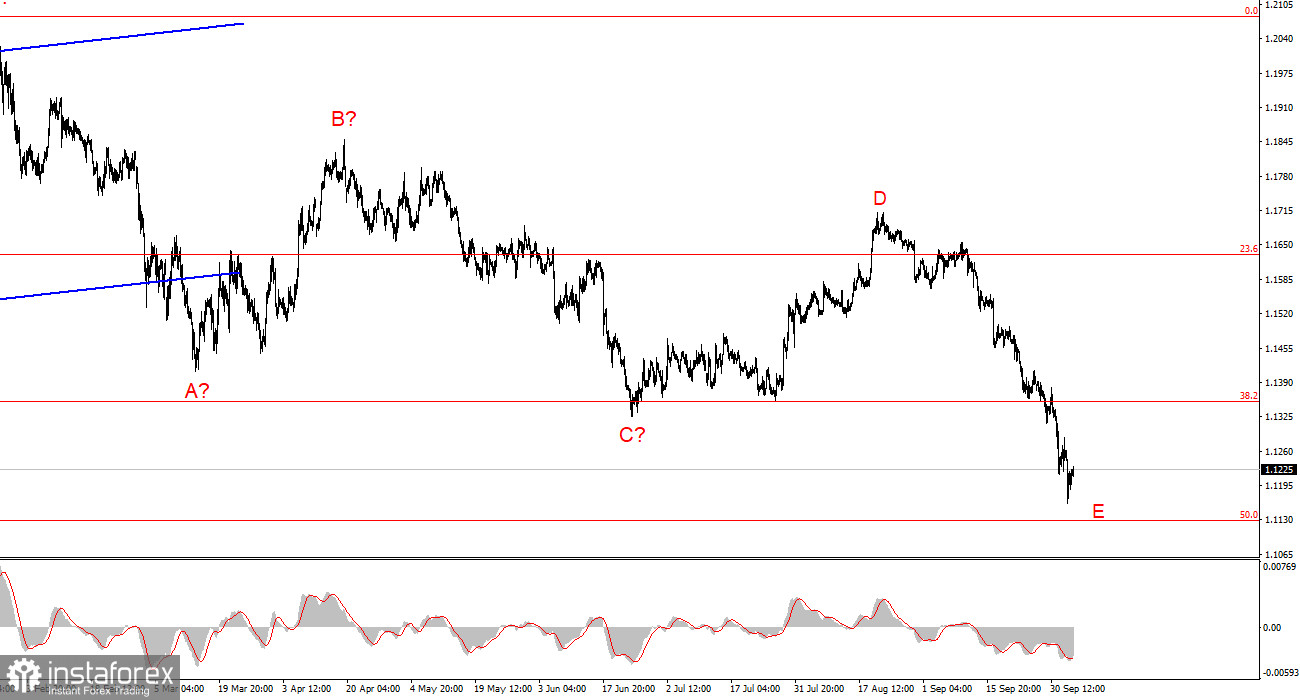
Based on the EUR/USD analysis, the pair remains within the global corrective trend segment A-B-C-D-E. If this assumption is correct, the decline will continue toward targets below the low of wave C at 1.1325. This scenario was previously considered an alternative scenario, and without the Federal Reserve meeting, it would have remained a secondary scenario. However, the Federal Reserve delivered a surprise, leaving the market with no other options but to launch another wave of US dollar purchases. However, buying has continued for several weeks, despite the absence of new supportive factors for the dollar. It would be preferable not to open short positions against this fundamental backdrop and instead prepare for a reversal.
On the higher time frame, a downward trend segment can be seen taking the form of A-B-C-D-E. Therefore, EUR/USD may continue to decline below the low of wave C, while the internal wave structure of wave E may take a five-wave impulsive form.
Main Principles of the Analysis:
InstaForex analytical reviews will make you fully aware of market trends! Being an InstaForex client, you are provided with a large number of free services for efficient trading.


